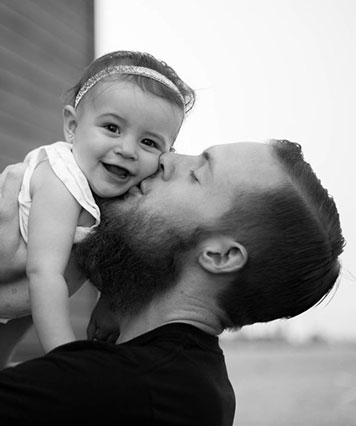
Fatherhood is very special. There are different ways to be a dad, logistically, relationally, and behaviorally. You can have children biologically, adopt or become a stepfather, or take on the role of fatherhood in relation to a younger person.
Parenthood develops profound change in people. It catalyzes maturation and the inner fabric of protectiveness, caring, and empathy. In addition to the imposing and sometimes overwhelming lifestyle changes in accord with such responsibility, parenting shifts perspectives on world views, values, and important priorities. From a male perspective, fatherhood is an opportunity to teach, lead, love, model, and connect offspring with the world. Being a dad is a privilege, a job, and a joy.
The late renowned psychologist, James Hillman, wrote that the main job of a father is to provide a functional link, a connection, between the child at home and the outside world. Hillman viewed the role of a father as helping the child transition from the protective nurturing enclave of the family to the demanding world into which the child must emerge and function.
Being a dad means different things to different men. We respond partially to the expectations of our children and families, but also to the echoes of our own childhood and the images we develop of what fathers are supposed to be and do. Fathers watch, copy, experiment, feel, savor, sacrifice, and change. It is a transforming development of soul that transpires over many years.
For most men, being a dad to a young child—especially the first one—may be filled with confusion. Infants are biologically more needy of their mothers, so fathers may often feel uncertain or marginalized about their direct involvement with very young children. There is a joke about men who tend to hold infants as if they were a glass vase—carefully and with respect and delicacy, but also with awkwardness and emotional distance. This image is a stereotype to describe that the bond between child and father grows differently than between child and mother. Maternal nurturing, feeding, and comfort are primary and necessary for the child’s earliest development. Fathers may feel relegated to changing diapers, carrying and transporting, attending when necessary, and assisting the mother in support of meeting the young child’s constant needs and demands placed on family and caretakers.
As the psychological bond develops intangibly, the father’s role grows with the child getting older. A man’s nature, experience, and interests will affect how he interacts and becomes involved with his child, as will the child’s gender, personality, and strengths and limitations.
Being a dad is a privilege. Not all men are destined to fulfill this role. Though most of the time it is biologically easy to father offspring, producing a child is a generous gift of divine nature. God is investing in creation, reproduction, and love. Fathers become trustees, and it is quite a privilege.
Fatherhood is also a tremendous job. Whatever their needs, gifts, or special circumstances, children are expensive, demanding, and needy for many years. They require much attention, and they challenge the previous self-centered mindsets that most fellows find natural as they grow into their own manhood. This must change and evolve in order to be a dad, especially a good one. Children necessarily coerce the development of habits that put others first.
Being a dad means knowing lots of answers—and knowing the humility of admitting ignorance and mistakes. Long before Google was available to source information, fact-check, and provide know-how, dads have had to serve as authorities, models, and teachers of information, values, and skills. Children look to their parents and elders for answers, but also to “prove them wrong” as benchmarks of their own puerile pride and self-sufficiency. Fathers must learn to handle power struggles adeptly and to assert authority while not being harsh or authoritarian. Providing leadership and correction while building a child’s sense of self-worth and independence is a delicate business.
The late writer and theologian, Dallas Willard, spoke of the parent/child relationship as perhaps the most perfect illustration of a “circle of sufficiency” in human life, and also as the place where the deepest and most lasting wounds can be given. According to Willard,
If a child is totally received in its early years by its parents and siblings, it will very likely have a rootedness about it that enables it to withstand most forms of rejection that may come upon a human being in a lifetime. It will carry its solid relationships to and from its family members throughout life, being sustained by them even long after those loved ones are dead. It will receive a steady stream of rest and strength from them.
By contrast, a small child not adequately received can actually die from it; or if it survives, it is very likely to be incapable of giving and receiving love in decent human relationships for the rest of its life. It will be perpetually “left out,” if only in its imagination. And in this matter, imagination can have the force of reality.
(Willard, D., Renovation of the Heart, 2002)
Paternal duties and responsibilities are intermingled with the challenges and growth endemic to the crucible of fatherhood. Along with what we give, the child contributes mightily and indelibly to our own understanding of ourselves—the nature that must undergo transparency and refinement in order to meet the demands of parenthood.
Being a dad exposes us to our own selfishness and flaws. It pits our pride and egotism against the pressure of family needs. It reflects us in the funhouse mirror of our children’s perceptions and wishes. Kids observe our habits, occassionally make fun of them, and often imitate them, sometimes to our chagrin. Throughout the growing up years, children look at the world through the filters of parents’ values, actions, and fears. They may not always accept what we do or say, but as parents, we leave a forceful imprint.
A dear friend of mine, Pastor Peter Wilkes, jokingly observed that in the changing age and mores that define masculinity and paternalism, it remains clear that the role and job of barbecuing on the grill unequivocally belongs to fathers. Pastor Wilkes was a mentor to me when I raised my two sons. I remember him repeatedly emphasizing that of all the variables, circumstantial differences, personalities, and parenting styles, the most important thing for fatherhood is that the man be there, reliably and as much as possible. There is something about the male presence, as father, that prevails as a grounding influence for growing children. It is better to be regularly there, even with flaws, than to be gone.
The reality is that fathers are not always there—cannot be for various relational or environmental reasons, (traumas, exigencies, work duties, and volitional absences). The tragedies of illness, divorce, incarceration, and death take some men away from their children. More than occasionally, men are just not up to the job; and even while present or living with their children, they are emotionally or responsibly absent or derelict.
When a father is there, however, the child has a model and, hopefully, a reliable resource and pillar of strength and security. The child has a human parent with whom to identify, exchange experiences, trust, and emotion, a psychological web to form a circle of sufficiency and practice in relations. Even fathers who “don’t wear the pants” in the family can anchor their kids for the storms of growing up. Moreover, they can share in the frustrations, delights, and achievements of their progeny.
I recognize that having and raising children constitutes my greatest accomplishment. There is little else in my history or imagination to compare or compete with what being a dad has done for and to me. My children’s legacy is their own matter. It’s sufficient that I was blessed to start and chaperone their journey from the beginning.
For me, being a dad required being at home or out with the family more than adventuring on my own. It brought the satisfaction and responsibility of providing for young and expanding needs. It meant attending games, performances, and events, supervising schooling, and keeping both eyes out for peers, dangers, and questionable influences. It meant standing my ground when extolling ethics, values, and virtues in the face of temptations and the chaff of our culture. Being a dad summoned the responsibility of esteeming and honoring women and motherhood as never before. Fatherhood tuned my tenderness and taught me the administration of discipline without anger. It brought home the reverberating message that my treatment of others will be evaluated and copied, carefully and repeatedly. It made me aware that, in my children’s eyes, I was incomparable, yet always being compared.
I savored explaining the workings of the world, as best I could. My heart rose and fell with my children’s victories and defeats. My pride swelled when I recognized genetic and familial traits emerging; and I rued their rejection of my own traditions and talents from my childhood and adolescence. Where the apples didn’t fall far from the tree, we gathered them together. Where they fell askance, I watched with wonder and worry. Was I too protective or too permissive? Too distant or unmatchable in my own accomplishments? Too demanding that they step up and compete successfully? Too capitulating in my indulgences and desires for them?
Those relentless responsibilities notwithstanding, the years pass with accelerating quickness. Seemingly suddenly, they are adults! The rules of the game change, but the connection is forever. Being a dad becomes increasingly about letting go. And still, I am there, and happily, blessedly available.
Fatherhood is more than DNA and barbecuing on the grill. Being a dad entails the crucible of human development and the furnace of challenge and refinement to provide for and relate to those who bring innocence, trust, and dependency. Being a dad is a grand privilege, a huge job, and an awesome joy!
Thank you, heavenly Father: I love being a dad!
— Mark Steinberg, PhD