As we observe individual differences among people, it is obvious that talents, abilities, and proclivities are distributed with fascinating variation. Some individuals are endowed with verbal eloquence, some with musical or athletic talent, others with mechanical or mathematical skills, etc. With genetics as a precursor, it’s still up to each of us to discover, develop, nurture, and practice what we are good at.
Regardless of the gifts and abilities you may have or wish you had, there is one unique ability that everyone should have to get along better with our fellow humans. It’s called accountability. None of us are born with this skill. It’s up to each of us to discover, learn, and practice being accountable for our actions and the consequences and impact they may have on ourselves and others.
To be accountable means to recognize and own one’s part in behaviors, relationships, and the effects of one’s attitudes and responses. Being accountable means being answerable, though not necessarily responsible. Though accountability and responsibility overlap and are often used interchangeably, there are important differences.
An account may be a report, an explanation, a network identity, or a financial statement. It is a fact-based description or clarification of some event or status. We do account for taxes, income and spending, to explain our whereabouts and time, and for our recollections. When we are accountable, we take ownership for what we did or said—but not for the reactions or responses of others.
Though accountability is similar to responsibility, they have important differences. Responsibility implies duty and possible associated liability for the execution and quality of duties or the ignoring of our duties. When something goes wrong, those responsible are often blamed or held culpable. Although this may sound like accountability, responsibility is more encompassing, denoting some level of control and possible liability.
To illustrate the difference: If you witness a car accident, the police or others may request your statement, report, or account of what happened. However, merely relating or describing your version does not make you responsible for the collision.
Accountability plays a key role not only in reviewing and/or recording facts and data, but also in acknowledging one’s presence, participation, observations, and perhaps interpretations of what transpired. When you hold someone accountable—to provide and account, you are not “blaming” them, but simply expecting them to report or explain a happening or event: their part in that happening or event, as well as acknowledging the effects, results, and consequences they experienced or observed.
We are all conversant with excuses—made by others and ourselves, consciously or blindly, such as shifting blame or responsibility, denying, playing victim, and the many versions and crafty ways of externalizing cause or portraying innocence or virtue. Perhaps we did it naturally as children and still do so, sometimes out of fear or embarrassment, and hopefully less often as we grow in our awareness, sense of safety, and integrity.
Some familiar responses when asked for a behavioral accounting:
“It’s not my fault.”
“I couldn’t help it.”
“I had no choice.”
“You have to understand.”
“What do you expect? What would you do?”
The desire and pressure to appear innocent, appropriate, or normal, and to avoid censure or other negative consequences lead to (self) exoneration from possible liability. However, by clearing oneself from alleged fault or guilt, we remove ourself from participation, emotional connection, and willingness to assume ownership of actions and possible responsibility.
Escaping or downplaying accountability can frustrate others and push them to double down on interrogation, nagging, and accusing.
Consider an example:
“You’re late again for dinner. I cooked and was waiting for you; I’m hungry, and now the food is cold.”
“I couldn’t help it. The meeting ran late and then there was traffic.”
A more accountable response:
“Yes, you’re right. I am late again. I can understand how that would upset you and I’m sorry. I am frustrated too, knowing that I inconvenienced both of us.”
An example of playing helpless or the victim that can turn lack of accountability into the onus of the person holding one accountable:
“How can you expect me to take out the garbage when I’m late for school/work?”
Such refusal to be accountable for one’s actions (or lack thereof) bypasses responsibility as well as the reality of one’s role in what transpired.
An absurd illustration is the story of the thief who is caught stealing a bicycle from a garage and, when confronted, blames the owner for not installing double locks!
Occasionally to make a wry point when facing someone’s litany of excuses, I offer this card:
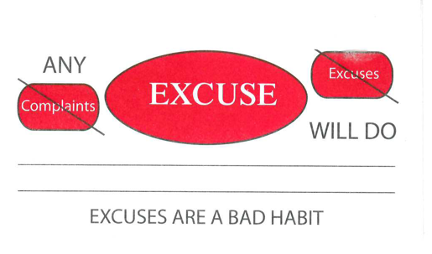
Many people live as if most of their problems are beyond their control. They assume an outlook of externalization. Of course, we cannot control everything. But being responsible, productive, and considerate requires ownership of one’s experience, even if certain antecedents and consequences were unforeseen or the result of external actions or circumstances
Remember that you and I participate in every decision we make. Being accountable means owning that participation, even if we were influenced by other people or forces along the way.
The habit of “I had to do it because . . .” or “What else could I do?” rapidly becomes a “victim” attitude of “Everything happens to me,” and furthers a lifestyle of shifting blame and responsibility to others. This is a selfish, irresponsible, and self-defeating way to live. That type of easy way out substitutes cheap avoidance for integrity.
We all know that things break down, promises are not always kept, and life interferes with surprises and exceptions. When we are unable to follow through or keep a commitment, acknowledge it, recognize the effect on others, and offer to remake the agreement. The letdown should not become a smear on anyone’s reliability and reputation or result in a grudge on the part of the recipient.
Remaking an agreement after it is broken goes a long way to compensating disappointment and retaining trust.
When remaking an agreement, the first step is to accept your part in breaking the agreement, along with acknowledging the consequences of the broken agreement on the other person—perhaps asking more about and then empathizing further. The next step is to offer to make a new agreement and see what would be acceptable. Be specific with regard to what you will do and when you will do it.
Usually, the other party is more receptive and amenable to a new offer once you’ve acknowledged and accepted your part in not keeping the former pact.
Although we have the power to develop and cultivate abilities, many skills are given to us by nature and genetic predisposition. We would do well to be modest and grateful about our abilities, and develop admiration and appreciation for the abilities of others.
Disabilities can occur with varying severity and are not the fault of those whom they afflict. We must regard those with disabilities as every bit as lovable and worthy as we are. As well, we must respect another person’s human wholeness despite a disability and do what we can to include and accommodate them.
We hold ourselves accountable and maintain that standard for others by modeling it, gently reminding others of the consequences of their actions related to us, and refraining from judging or emotional accusations when holding others accountable for those actions.
All people are born with abilities and disabilities of sorts. But no one is born with accountability. That skill must be acquired and developed, valued and practiced. It becomes a part of ourselves through choice and deliberate intention.
There is a profound realization that can be life changing: we don’t own anything. Whatever we have has been given by God and can be taken away at any moment. Our possessions, positions, relationships, even our bodies are on loan. Every one of us is living on borrowed time.
With this in mind, to what can we lay proper claim? I believe that accountability arises in this realm. Our actions, story, commitments, and word are all we really have to own.
Even with the best intentions, some agreements, promises, and commitments will be broken or fall by the wayside. Being accountable, accepting our responsibility, acknowledging the impact of your flaws upon others, and offering to renegotiate a new agreement as appropriate establishes the foundation of trust, integrity, responsibility, reliability, and good relations.
Most things in life are transitory. I find that the two things I can most rely upon are God’s Word and my word. I try to keep them both.
— Mark Steinberg, PhD