
We’re all familiar with the refrain, “Excuse me.” It’s a part of social etiquette. “Excuse me” is heard when a person inadvertently crosses a boundary, such as bumping into someone. It’s offered when someone wants to cross a boundary, as in jumping ahead or breaking through a line. It’s also intoned as a polite way of interrupting a conversation to get attention. Sometimes, it’s intoned as a question by an affronted person, as in “Excuse me? What do you think you’re doing?”
“Excuse me” is an acceptable and polite request to be pardoned for some interruption or impropriety.
Then, there is the hidden agenda of Excuse me: the commission of transgressions, or the failure to carry out expected, instructed, or agreed upon behaviors. Rather than say or request “Excuse me,” many people will simply make excuses for themselves when confronted or reminded of their failure to perform adequately.
All of us make excuses. We try to exonerate ourselves from blame; and we often feel compelled to apologize for disappointing someone or to evade accountability by making up a story for what we did or didn’t do. With some people, this habit is excessive and chronic. You probably can think of someone who fits this description.
The nature of the mind is that it makes up stories. That constant chatter (yes, you have it, too) that proffers opinions, criticisms, “likes,” and other comments is our mind’s way to interpret perceptions, organize reality, and help us navigate a complex and ambiguous world. I call it the “narrative.”
Sometimes, I refer to this mentally active narrative as the “White House Press Secretary” of the mind. Just as the job of the White House Press Secretary is to report upon, justify, and favorably “spin” the administration’s policies, the job of our mind’s narrative is to support how we feel physiologically through the filters of our beliefs and values, according to the events and circumstances evolving around us.
For many people, the mind’s constant activity becomes stressful. Often it races, flooding more information and opinions than necessary or comfortable. The racing thoughts can interfere with sleep and relaxation. They can also rush to the forefront to defend and justify. The mind loves to make excuses. We tend to subscribe to this natural ability to explain away broken promises, lack of accountability, wayward assumption of responsibility, forgetfulness, self-justification, and indignation about the world’s demands.
It can be very frustrating to point out—perhaps repeatedly—the failures or lack of follow through on the part of others. When you hold someone accountable, there is often “pushback,” resistance, or excuses. Even when told nicely, the recipient tends to defend, taking the statement of facts as nagging, confrontational aggression, or an unpleasant reminder of one’s own insufficiency.
Many people don’t like to be held accountable. So they make excuses, feign forgetfulness, promise to follow through or do better next time, or simply balk. Though these interactions are stressful and produce conflict for those who are at the effect of their counterproductive behavior, the excuse tactics usually “work” and perpetuate the maladaptive status quo. It’s simply burdensome to keep reminding someone of things left undone, not finished, or not submitted on time (e.g., paying household bills or handing in completed homework assignments when they are due). Reminding and holding someone accountable can make you feel like the bad guy. Excuses, stalls, stonewalls, and delays establish an embedded script that signals the need for constant monitoring and supervision. The instigator unwittingly “trains” (reinforces) the slacker to wait out many reminders; in turn, the slacker “trains” the reminding person to repeat many times before the task gets done. Often, the instigator ends up doing it himself—so the slacker gets away with lack of performance (by default).
Excuses are just reasons that substitute for desired results. They may take many forms, come in different guises, and appear justifiable. But they are charlatans that mask the lack of performance.
Habitual excuses make for bad relationships, resentments, stress, conflict, and mistrust. The thing to do when you break your word is to acknowledge it, apologize, and remake the agreement. Developing this habit leads to self-respect, integrity, trust, and reliability. The poor alternative is to delude oneself that “any excuse will do.”
Although the frequent pattern of response to being held accountable involves some sort of excuse, another common response (often appended to excuses) is that the person will demurely say, “I’m sorry.” While this acknowledgment and apology is a start in the right direction, it’s typically not enough to keep the transgressive behavior from happening again. When the transgressor apologizes, it has the effect of stifling further progress on the accountability issue and its relationship with future behavior. It’s hard to criticize someone when an apology is genuinely offered. And criticism (though often the default follow-up, due to frustration) is not necessary or helpful. What you want is a reliable plan to alter future outcomes.
Here are some suggestions for responding to excuses that avoid the trap of reinforcing them:
Responding to “I’m sorry”
Say, “I appreciate your apology. I’m glad you recognize that your behavior caused a problem. ‘Sorry’ is a good start, but it’s not enough to keep that behavior from happening again. You and I both know that from the history. Let’s do better by coming up with a plan to alter the outcome in the future. Here’s my idea… What do you think? Will you commit to that?”
Responding to “I forgot”
“Forgetting doesn’t let you off the hook. It’s just a reason to explain away the bad behavior. Your promise/responsibility to do (name the behavior) left me hanging. Forgetting doesn’t excuse consequences. It’s important to change this behavior from now on.”
Responding to “I didn’t do it” or “It wasn’t my fault”
“Here’s what happened (or didn’t happen that should have): (describe the facts and evidence). I’m just recounting the evidence. It’s not about blaming; it’s about holding you accountable.”
Excuse card consequences
As an adaptation from more complex behavior modification systems, I’ve devised a quick and simple response to excuses. See below.
An excuse card (see example pictures) is a type of response cost. It’s like a traffic ticket—something you have to pay because you crossed a boundary or did something that was not allowed, and you got caught! Though not the same as a punishment, a response cost of sufficient strength is usually an effective deterrent; it associates a behavior with a cost that is predictable. Response costs may be attached to behaviors that are allowable, but expensive (as in the case of credit card interest or late fees) or prohibited (as in breaking rules). Response costs are effective when they make certain behaviors predictably expensive, thereby tending to discourage or deter the behavior. Response costs serve as capitalistic (rather than moral or conscience-based) controls over behavior.
Here’s how to use excuse cards as response costs to stifle undesired behaviors, particularly verbal excuses and associated lack of proper performance:
When offered an excuse, write down on the excuse card the date and a very brief statement of the excuse:
May 19, 2018: Said he “forgot” when reminded that he didn’t take out the garbage
Give the excuse maker the top copy of the excuse card. Keep the bottom (yellow) copy in a safe retrievable place.
Tell the excuse maker that he must do two things to earn your top copy that will nullify and neutralize the excuse response cost:
Explain that five excuse cards cumulatively not neutralized will result in the forfeiture of some possession or privilege for a specified time period.
Explain that five excuse cards neutralized and handed back to you (both copies of each excuse card) will result in a specified incentive (reward).
Using the excuse cards as described will discourage excuse making. This procedure will also emphasize and reinforce accountability. As well, using this system will help you communicate clearly the important fact-based messages and avoid your becoming trapped in unproductive arguments.
In order to implement this system effectively, you must carry excuse cards or have them readily accessible—after all, excuses are likely to happen anytime and anywhere!
Keeping a copy (records for yourself) is crucial. This serves as monitoring, evidence, a track record of behavior patterns, and a situational reminder to the excuse making person that you are keeping careful track of the excuses.
Although you don’t want to encourage excuses by rewarding their “make-up” behavior, the offering of reward incentives for doing the right thing after a transgression tends to have a highly corrective effect on programming more responsible behavior. It’s a very good response to bad behavior and an effective substitute for focusing and harping on what the excuse maker did wrong.
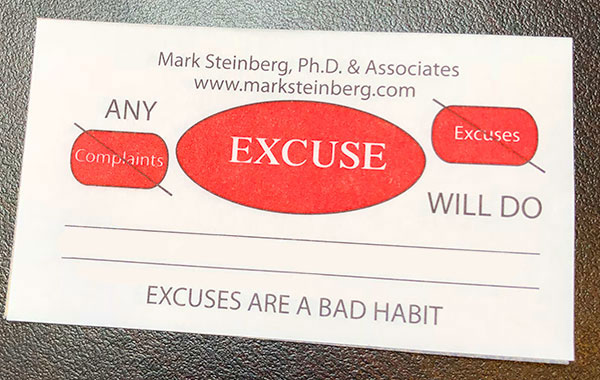
Blank excuse card.
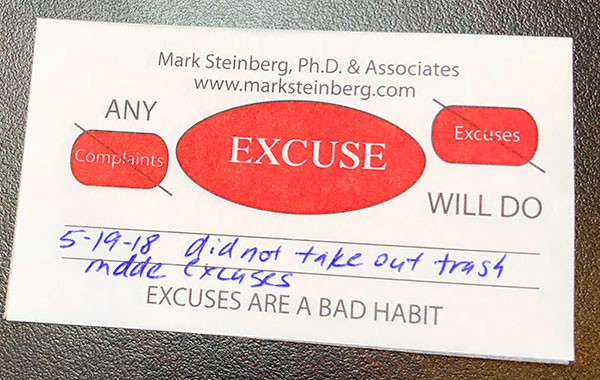
Filled in excuse card.
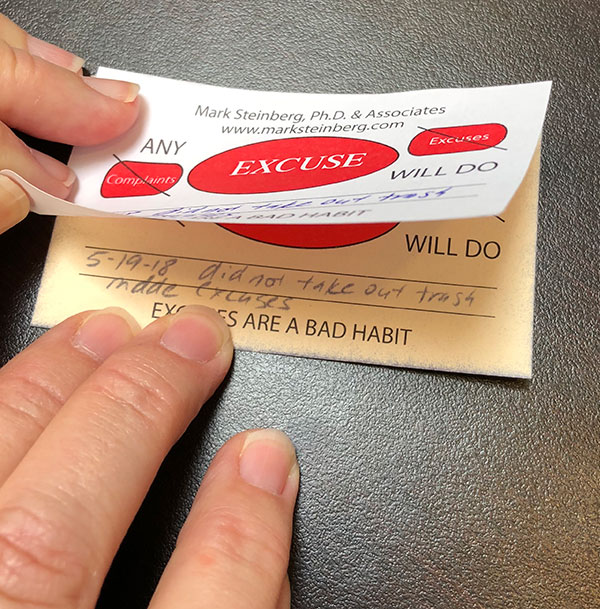
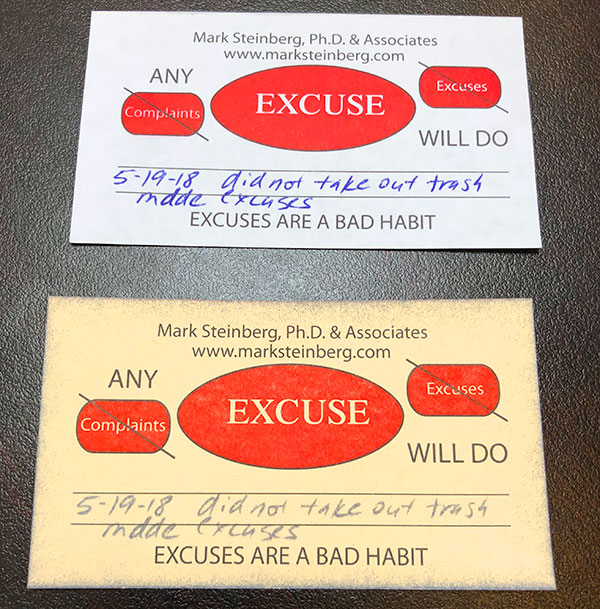
Duplicate imprint excuse cards.
Excuse card video.
Excuses are a routine part of saving face, masking aggression, and obtaining permission or forgiveness. However, their overuse leads to irresponsibility, resentment, mistrust, and conflict.
By paying careful attention to how you engage with people who habitually make excuses, and by implementing a system of response costs to remediate (which actually translate to benefits in shaping more productive) behavior, you can deter excuse making and set standards for accountability in communications and behavior in your relationships.
As we become more aware of the tendencies to make excuses, we will appreciate how this habit stands in the way of our getting the results we want.
Reflect upon this:
“You can have a lot of what you want in life… or, you can have the reasons why you can’t have what you want.”
People who habitually make excuses and complain unwittingly substitute “reasons” for their failure and unhappiness to take the place of achieving goals and positive results.
— Mark Steinberg, PhD
You can order excuse cards (duplicates with white and yellow copies of each) through my website or by calling (408) 356-1002. They are $14.95 per one hundred (plus tax and shipping).
Or, by ordering my e-book, Reality Reports: Essays on Mental, Emotional, Spiritual, and Social Issues in the Twenty-First Century, you can download an 8” x 11” page of ten single excuse cards which you can then cut apart and use (you will have to write and keep your own copies). Here is a reduced size example of the Excuse Card Sheet available when you purchase Reality Reports: Essays on Mental, Emotional, Spiritual, and Social Issues in the Twenty-First Century.