Groucho Marx said, “Outside of a dog, a book is a man’s best friend. Inside of a dog, it’s too dark to read.”
I say, “Outside of a marriage, you’re lucky if you have a best friend, and you’re at risk for loneliness and envy. Inside of a marriage, you’re lucky if your spouse is your best friend, and you’re at risk for boredom and feeling trapped.”
As a professional therapist, I observe and hear about many marriages. From confidential reports and complaints, I peer inside many relationships. Though I’m privy to minimal details and the subjective bias of the confiding partner(s), I hear the frustrations and glean insights about the dynamics of the marriage and how it works (and/or doesn’t).
A marriage relationship rarely appears to those outside the relationship the way it feels and looks to the spouses. Inside the relationship there is often darkness that’s hard to fathom. Over time, the attraction and spark that ignited and fanned the relationship gradually erodes, and quirks that were once endearing or ignored surface as irritants, grievances, conflicts and obstacles to harmony and intimacy.
Some relationships flourish and deepen as partners learn to adjust, weather adversity together, and value the pluses more than the minuses in continuing to derive satisfaction with each other. Many marriages wither in pleasure but endure with ambivalence and hardship for the sake of children, finances, “commitment,” fear, or inertia.
Options for Unhappy Couples
In unsatisfactory marriages, there are the following typical options:
When “for better or worse” reaches a dire level, it’s possible to leave, end the formal relationship, separate, and put up with the consequences. The “I didn’t sign up for this” response represents surrender to the expectation or conclusion that things will not get appreciably better. In the words of marriage therapist and author David Schnarch, “Divorce is an attempt to stop communicating.”
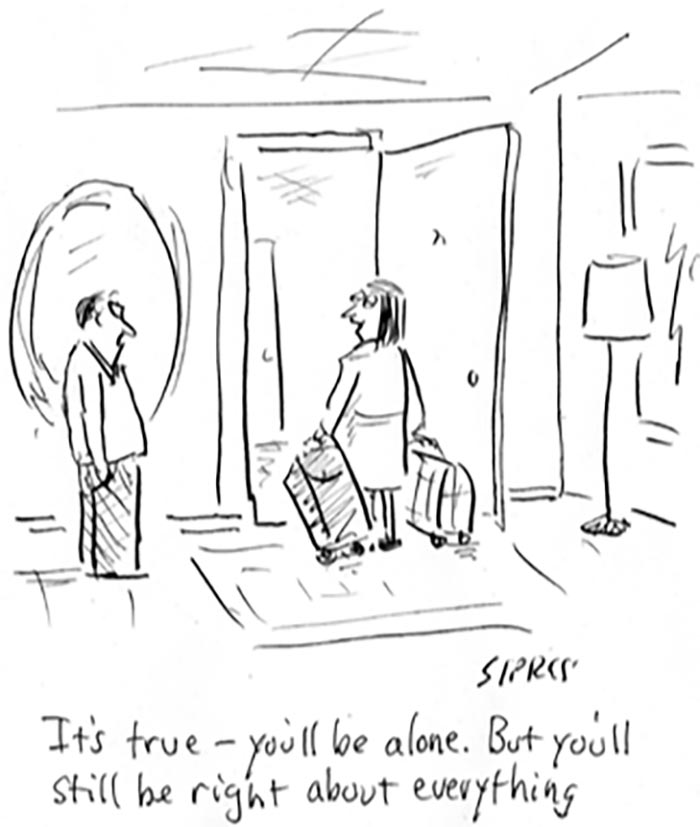
“Marriage is the chief cause of divorce.” — Groucho Marx
Often in relationships, one partner dominates, relentlessly pushes to get his or her way, and frequently wins. While this works well for the controlling partner, it disadvantages the other partner. As the saying goes: “when I win, we (the relationship) loses.”
Converse to control is conformity or submission. In this dynamic, conflict subsides when one partner conforms to pressure by the other. Though this arrangement tamps down the relationship temperature, it breeds resentment and disrespect. Control and conformity characterize many dysfunctional and unhappy relationships, often for years.
In the spirit of flexibility, reasonableness, and more sane survival, couples tend to compromise. Though compromise is naturally a sensible part of human dealings and plays a role in any functional relationship, compromise as a modus operandi for avoiding and settling conflict sabotages intimacy and contributes to alienation and lack of self-respect. When compromise becomes the default relationship theme, partners grow more unhappy and distant.
Key Dynamics in Marriage
As a veteran institution, the subject of marriage has evoked legions of commentaries, writings opinions, seminars, and theories. I, too, have written a book on marriage (Staying Madly in Love With Your Spouse: Guide to a Happier Marriage). My aim here is not to give you a discourse on how to be happily married or to tell you that you should be happily married. Rather, I offer you a summary of some key dynamics that determine marital satisfaction and harmony and some guidelines regarding what happy couples do to promote and maintain their satisfaction.
Here are some key dynamics that underpin the degree of marital satisfaction and harmony:
Intimate relationships can be very rewarding; but, they can also breed ambivalence, conflict, resentment, and trauma. Any emotional and contractual environment that signals dependence and need carries the potential for and probability of mixed allegiances: the ongoing commitment and devotion to the other person in the relationship having to meld with the unfettered assertion of one’s own identity, values, boundaries, desires, and beliefs.
Whenever there is continued conflict between partners, there is always underlying trauma and grievance. These are seldom articulated and often intertwined, thus complicating and obstructing conflict resolution.
The trauma aspect is the emotional reaction (usually automatic, partially subconscious, and triggered by the disagreement). The grievance part refers to the component of the conflict that derives from the merit of the complaint—that is, the purported transgression or violation that makes someone less whole.
In order to effectively resolve conflict, it’s necessary to identify traumas and grievances separately and to adequately deal with each individually.
We enter intimate relationships with aspirations for fulfillment. You want your partner to meet your needs and make your hopes and dreams come true. You’ve probably expressed these to your partner (or think you have) many times. When these aspirations and needs go unmet, frustration builds and conflict may emerge. You cannot understand why your partner is ignoring or holding out on you. However, it’s likely that your partner views what you want very differently.
Also, each of us brings our “selves” to the relationship, and that includes, for many, the unwitting need for a partner to make us feel emotionally and relationally complete as a person. This is a heavy and unrealistic burden for the partner.
Expectations are a key and primal aspect of how we navigate through the world. Expectations form our outlines for planning, trust, and predictions based upon past experiences and perceptions.
In marriages rife with conflict and dissatisfaction, what appears to one partner as reasonable needs, hopes, and dreams feels to the other like expectations. Unbeknownst to the person who trusts these aspirations to a spouse, the spouse feels burdened by expectations that can seem overwhelming. There’s not only a disconnect in the way that the partners view what they want—there’s often a resentment by the other party that such “expectations” are unreasonable.
In addition to the problem of unmet expectations and differences in perspective about what your partner should do for you is the issue of what you think you are entitled to or “owed” as an inherent right in the relationship. What exactly are your partner’s obligations? How often and to what extent? How does your partner see this and how was this arranged? What do you owe him or her?
Here’s an underlying dynamic that often sabotages marriage happiness: if you are owed or entitled to something, then your partner cannot give it to you freely as a gift. If someone owes you money, then payment is an expected obligation and will not be received as a blessing or offering. Instead, its absence or withholding creates conflict and resentment.
Therefore, if you’re not getting from your partner what you need or “deserve,” then it becomes very difficult to perceive or accept what your partner gives as a blessing or love offering, as you will likely add it to the ledger of imbalanced “accounts receivable” in the relationship. This dynamic erodes intimacy.
Solutions for Improvement
Though you already know that you don’t “own” anybody and that you cannot singlehandedly change your partner, please keep in mind that focusing on and implementing what you can do is empowering and can lead to great effectiveness and peace, even if you are living in a problematic relationship. Here are some potential solutions to the quandaries outlined above:
Whenever there is continued conflict between partners, there is always underlying trauma and grievance. These are seldom articulated and often intertwined, thus complicating and obstructing conflict resolution.
In order to effectively resolve conflict, it’s necessary to identify traumas and grievances separately and to adequately deal with each individually.
The trauma aspect is the emotional reaction (usually automatic, partially subconscious, and triggered by the disagreement). The grievance part refers to the component of the conflict that derives from the merit of the complaint—that is, the purported transgression or violation that makes someone less whole.
The traditional concept of trauma is predicated on an assumption of a catastrophic event outside the range of usual experience. However, trauma encompasses a much broader range of causal situations and is a very common occurrence. Traumas are universal, and they occur intermittently in everyone’s life. Recovering from traumas is necessary for basic physical functioning and mental and emotional health, and can be accomplished routinely by most people (given the right tools, training, and support).
There are indeed many forms of trauma that occur when people are subjected to harsh conditions, abuse, overwhelming negativity, rejection, racism, isolation, poverty, and so forth. For many people, however, it is overwhelming enough just to have to deal with the more mundane traumas that result from the daily interactions, demands, and conflicts typically associated with ordinary relationships.
When your spouse does not react in the way you want or expect, it can be emotionally traumatic. You need not be oversensitive or even know that the trauma is occurring. You can, however, tell by the after effects. Remember: the nature of trauma is that it causes us to relive or anticipate an event or reaction that previously left us hurt, shocked, exposed, or defenseless. So, when you find yourself (or your relationship partner) re-visiting the same conflicts, scripts, and (quickly accelerated) emotional responses to the faintest of cues, you will know that a trauma has been incited and activated.
For these traumas, you don’t need access to an emergency room or years of therapy. What you do need is the realization that you are probably reacting to some provocation that stimulates a less than conscious, unresolved emotional vulnerability that initiated a trauma. Such awareness will enable you to see your inner responses and your outward behavior as reactions to a trauma that you may perceive viscerally as necessary, but which are neither a function of choice and clear thinking, nor conducive to planning, keen observation, evaluation, and problem-solving.
Resolving traumas, particularly as they relate to and impede your relationship can be facilitated quickly by modern techniques offered by many experienced therapists using appropriate methods. With professional guidance, you can also learn to do this on your own.
We typically find the word grievance in a formal context, such as a court proceeding or a labor dispute. This is in accordance with living in a rule-based society where there are procedures for petitioning or complaining about violations and transgressions of the codified rules.
Grievances are based upon breaches of contracts or agreements; these breaches are, in essence, violations of rules. Some rules are written into law, while others are commonly accepted by values in the culture of concern.
Settling grievances is so much easier after the traumatic emotions and triggers are resolved. Then you can identify and evaluate the other party’s complaint based upon a factual analysis of the merit (legitimacy) of the grievance.
For an extended discussion of traumas and grievances, read my article, Traumas and Grievances in Relationships.
While it is natural and reasonable to share your needs, desires, hopes, dreams with your spouse, recognizing that he or she may be able or willing to satisfy only part of them and that they may be received as burdensome expectations will help you relinquish the “owes me” attitude and frustration.
Yes, your spouse does have certain marital obligations—but the parts involving becoming a complete and satisfied person are really up to you. Your partner cannot complete you psychologically or emotionally. Your partner is an ally and ideally a helper in assisting your journey through life together. There will undoubtedly be dashed hopes and unfulfilled dreams and expectations in any relationship. The more complete you are within yourself, the easier it becomes to let go of what the other person doesn’t give you.
Happy couples know how to give and sacrifice while expecting little in return. It involves a “flipping the script” in attitude and behavior, whereby each partner assumes the position that he or she owes everything to the other while, in turn, is owed nothing. This clears the way for receiving what the partner does or gives as a gift and blessing.
To do this, one must follow the biblical principle to “love others as God has loved you.” Putting this love into practice means that out of gratitude for how God has loved and forgiven you, you practice such undemanding love by giving to your partner without expectations in return.
And, what if your partner does not do the same? Well, as explained, you relinquish expectations. Surely, the marriage will be better if both partners engage and practice this spiritual principle. In a relationship where both partners race to the back of the line, there will be more love, consideration, sacrifice, and giving. Even if you are the one doing most of the giving, you will be happier and less frustrated.
When you embrace the attitude that you owe whatever you can give to your spouse apart from expecting reciprocity, you enter and experience a delightful realm of sacrificial and satisfying love. Giving such unencumbered love regularly while setting aside your perceived entitlements allows generosity and compassion to play a fulfilling role in your life.
By owing everything and expecting nothing, you lift the burden of “have to’s” or relationship debt from your partner. You also model sacrificial love that tends to motivate the other person to do more for you.
You cannot repay God for loving and forgiving you so completely and unconditionally. When you realize this, a profound change in heart occurs that stirs you to want to give back to others by obeying God and copying his love as best you can.
When the honeymoon is over, there will undoubtedly often be a gap between your expectations and your partner’s behaviors. If you rue, criticize, and demand, things will likely devolve. This is not to dismiss the importance of accountability. However, there is a habit you can develop that’s likely to build up you and your partner: assume the best in your partner. This means not turning a blind eye, but rather crediting your partner with best intentions. Instead of thinking “Oh, he’s late again,” assume “I bet he feels stressed about being late. He didn’t want to disappoint me and he’s probably frustrated that something came up and delayed him.” “Yes, she spent more money than I would have liked, but she must have felt a need I don’t quite understand, and I know she didn’t do it to hurt me.”
By crediting your partner with the best assumption, you are making a choice each time, and building a habit of generosity and deference. Love becomes not blind, but instead less critical and more binding of your own anxiety and resentment. You become more in control of you.
Givers and Takers
People develop personality and behavior characteristics that can fall into patterns of “givers” and “takers.” From ordinary experience, you’ve observed and interacted with various forms of selfish and unselfish behavior that tend to repeat thematically.
In most relationships—even very satisfying ones—giving and taking are unevenly distributed. Without the infiltration of resentment or entitlement, imbalanced giving and taking does not have to contaminate compatibility or satisfaction. Usually, one person is more of a giver in any of several domains; money, sex, caretaking, etc. The balance of wants and offerings need not be equally weighted. Givers are used to giving and takers are accustomed to taking. In loving relationships, giving and taking are not transactions based on commodities. Rather, they are personal patterns established over years of development for each partner and adapted to a dyadic relationship. Behavior exchange where one person does or gives more can easily fit into the personal styles of each and can work out satisfactorily. When partners have trust and intimacy, this dynamic occurs naturally.
Wonderful One-Sided Relationships: Choice
As an example of happy one-sided relationships, I think of my relationship with my dog. I do everything and owe everything. I pay for it all. My dog has never bought me anything, prepared a meal, or run an errand. Yes, she’s faithful and always around—that’s the great companionship part. (Okay, she doesn’t complain or argue with me, but we won’t get into that inference.) Of course, the comparison is crude and unequal: dogs are not spouses. But, I want to illustrate how natural it can be to offer everything in love without reciprocal return or equal expectations.
Obviously, caring for a pet is one-sided. A spouse is not a pet (though you may have a “pet” name). If you can “espouse” the attitude of owing everything, yet expecting little to nothing, you will act more pleasing and likely be more content.

Love can be reciprocated or unrequited. Sometimes you may love someone but feel that you aren’t getting enough love in return. Your “dance partner” may appear listless, unresponsive, and unenthusiastic, and you may revert to frustration or bitterness because this person’s love for you is not as deep or fulfilling as you’d like it to be.
The capacity to experience love—both the giving and the receiving—resides within you. Yes, the exasperating behaviors of your spouse and life’s upsets and conflicts may temporarily influence your mood, energy, thoughts, and actions, but the continual choice to experience love is always up to you.
The preceding may sound like some of the platitudes you’ve encountered about having a positive attitude and taking responsibility. It’s true that a good attitude and a sense of responsibility can help, but feeling and expressing love involves choice. You and your partner have chosen to be on the floor together, and you must decide how you want to choreograph the dance.
If you want to remain loving and expressive toward your spouse, you must be in charge of how you experience and relate to love. You must take it upon yourself to initiate the dance, and you must be persistent in inviting your partner to dance with you.
When you’re deeply in love, you desire engagement with your spouse, you feel enthralled when you’re engaged, and you find satisfaction after engagement. Though your spouse is the object of your love, the capacity for and practice of loving arises within you. You cannot depend on your spouse to determine your steadfastness in desiring engagement, feeling enthralled when you’re engaged, and finding satisfaction as a result of that engagement. You must deliberately choose to play an influential and proactive role in the dynamic.
The bad news is that your partner will probably demonstrate behaviors and quirks that challenge your amorous feelings and inclinations to be open, receptive, and intimate. The good news is that you can weather and prevail over these obstacles and remain steadfastly in love with your partner even through prolonged times when you are not treated well or feeling well.
Ironically, some of the most intense, self-confidence-building love that you feel for your spouse will derive from discovering that you can still stay in love even when you are ignored or mistreated. This is because you realize intuitively that you are capable of love, that your love is real and resilient, and that your feelings, commitment, self-control, and sacrifice cannot be hijacked by the whims, flaws, or infirmities of the person to whom you are wedded.
In order to love this way, you must rely on the example and experience of God’s sacrificial and unstinting love for you.
“My command is this: Love each other as I have loved you.” (John 15:12)
I know of no other way or power to do this. Fortunately, God’s love and example is more than sufficient.
Trapped, Stuck, or Liberated
“Marriage is a wonderful institution, but who wants to live in an institution?” — Groucho Marx
As the ins and outs of marriage are diverse and complicated, I’m not offering a simple fix or suggesting that you should stay married or even be satisfied. Perhaps the insufficiency or despair in your relationship involves a depth of disappointment or constraint that only you can know. For many, the relationship has deteriorated, capitulated to best efforts and longsuffering, only to end in calling it quits. No judgment from me.
Marriage is hard, relationships are demanding, and sacrifice requires maturity, gratitude, and practice. If you can pull it off, there is wonderful reward from contentment, pleasing, and commitment to another person (rather than to the “relationship”).
There are many reasons to stay together and many reasons to split. Each partner makes a choice. Though your relationship may have many flaws (despite your desires, expectations, and efforts), you have much choice over what you give and how you interpret and gain satisfaction from what you receive.
Herein, I share with you some perspectives, insights, and tools for making the most of an imperfect union.
“Outside of a marriage, no one really understands what you’re going through. Inside of a marriage, only you can determine its worth and what you can do to make it more worthy.”
— Mark Steinberg, PhD