Engraved on the side view mirrors of most cars are the words, “Objects in mirror are closer than they appear.” This notification advises drivers that the optics of these mirrors may mislead regarding distance depth and actual presence and potential danger of approaching vehicles. It’s a dynamic that experienced drivers are familiar with and a reminder to avoid complacency, a check on our limited perception.
In the era of the novel coronavirus, the novel social distancing brings new awareness about limitations in perception and proximity, some visible (people) and some invisible (microbes, aerosol droplets).
Forays in public have recently become “expeditions” fraught with advisories, prohibitions, and heightened anxiety. Most of the population has been admonished to stay home except for essential outings (food, doctors, pharmacies). Thus, going to the market and being out in public now carries new rules. We are supposed to maintain at least a six-foot distance from others. Stores have taped and marked grid lines to demarcate distances and separate shoppers. People are on edge; the lines between worry, compulsiveness, and paranoia have become blurred.
When I’m out getting groceries, I consciously try to obey the rules. Yet, I still get stern looks and some verbal warnings from cautious people who pass me in the grocery aisles. They suddenly move away, as if I had a weapon or bad breath. I imagine their disapproving frowns behind their masks. It’s all quite unsettling. From the gloves to the sanitizing and handwashing, those ominous grocery carts and the invisible threats on packages, surfaces, and in the air—it’s enough to make me wonder if I’m worried enough. Am I in a Chernobyl time warp?
In college, I had a psychology professor who coined the term, rapanoia. That is, if paranoia means being afraid of things without cause or potential to harm you, then rapanoia means not being fearful of things you should be wary of that pose a danger or imminent threat. The professor’s insight was inventive then and relevant now. I daresay that the spring breakers on the beach recently demonstrate a woeful case of rapanoia.
I accept the inconveniences and the lifestyle constraints. Nobody likes this situation. Microbes don’t discriminate or persecute. They are simply opportunistic reproducers. I’m grateful for the scientific and governmental leaders who have stepped up—and, of course, for the medical professionals waging health wars at great personal risk and sacrifice.
The mirrors and reflections in this moving montage are many and varied. It’s hard to gain perspective and see clearly. Some objects are closer than they appear and some, through history, may seem distant, even as they catch up with us and recapitulate. Memories of Ebola, SARS, and AIDS are strong and pertinent. The 1918 Spanish flu pandemic is a century old, but disturbingly closer now in the mirror of history.
Social distancing feels odd and awkward. Sympathetic to those habitually afflicted with social anxiety and avoidance, it’s unnatural to avoid handshakes, hugs, and routine physical proximity. Body language and nonverbal behaviors have elevated to new sensitivities. Peripheral humans and those outside our identified boundaries of enemies and adversaries have now become potential threats. That person in your side or rear view may be an asymptomatic carrier. We’re in a new world of subterfuge, of human and microbial spies. It feels unsafe.
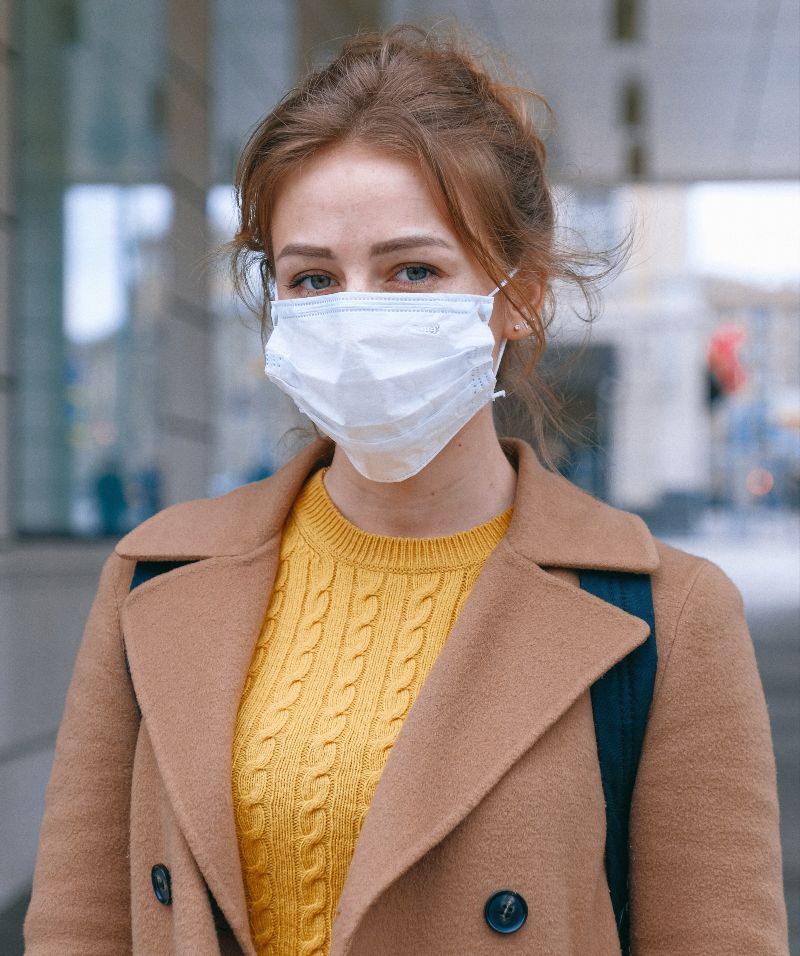
Add to this new social order the recommendation to wear masks in public. The prevailing medical view (thus far) is that masks may protect the wearer from transmitting coronavirus to others, predicated on the belief that many carriers or COVID are asymptomatic, especially during contagious periods.
Interestingly, this infectious disease protocol resembles certain psychosocial personality models that use the concept and term, mask. Famous psychological theorists like Carl Jung posited the notion that our personalities are layered with innate and instinctual needs and behavioral preferences intermixed with characteristics that are projected to others for the sake of perceived propriety and social expectations. In this model, your personality and temperament are a mixture of the real you and the cloak of what you want others to see about you, according to your goals and ideas about their expectations. Such projection is called the mask. One school of thinking (which I believe has merit) holds that the degree of difference between your mask (persona put on for others) and the real you (behaviors and traits most natural and comfortable for you) represents the degree of stress you experience navigating between these sets of characteristics and behaviors. In essence, it takes psychological energy to come across as different than you really are.
There are personality tests that can measure these characteristics and their differences. Such assessment can be quite useful in identifying and clarifying your needs, preferences, and behaviors, whereupon you can become more conscious of the differences and possible drain upon your coping resources. This awareness can also help hone self-control and more accurate observations about your interpersonal interactions. Recognizing discrepancies between the real you and your projections can relieve stress and give you more presence and control.
The term, projection, is a well-known psychological concept describing a tendency to perceive another person of displaying tendencies (usually objectionable) of yourself that you cannot or may not want to see. Projection is an evasive psychological defense mechanism. It is also a mask to try hiding behind, but one that others usually see through. Projection protects you from yourself, in a manner of speaking.
For the sake of protecting against infectious disease, many people are wearing masks in public. Biologically, the mask shields others from you. There are psychological masks, some invisible and some materially symbolic. In Muslim tradition, many women wear veils over their faces—the hijab, burka, or niqab—to show traditional modesty in the sacred religion. The intent is to protect or hide the woman’s “real” self from others, in part.
Traditionally and contemporarily, there are medical, social, and psychological methods of setting boundaries and barriers to keep us apart from others. These may be partially effective; but, in reality, objects (including ourselves) are closer than they appear. Masks, optics, and other perceptual distortions do only a partial job of obfuscating the realities, often invisible but nonetheless consequential.
I must add that walking into a bank with a mask over my face seems quite strange. At least I don’t wear sunglasses.
In addition to the material and psychological screens that distance us, we now have virtual screens—devices that connect us in real time representationally, while masking the actual distances separating those interacting.
Technology allows virtual users to appear closer than they actually are. What an interesting twist on representation, connection, social interaction, and transparency. Video conferencing is becoming more commonplace. Churches stream sermons. Television talk shows feature familiar hosts at home conducting remote interviews. It’s a brave new world. Thankfully, we have modern technologies to connect us in uncanny and convenient ways. The global evolution of routine and widespread travel that facilitated the explosive COVID pandemic has accompanied the growth of technology and the virtual world that facilitates digital connection. Computer viruses make devices sick, not humans. While we contend with this current biological monstrosity, we can still communicate and share information, images, and feelings.
We can participate in the virtual world in real time and with high resolution. In this mode, people appear closer than they really are. Unlike the three-dimensional world of actual road traffic, watching the screen is safe. You can navigate from one channel or stream to the next. If you crash, all you have to do is reboot. There are advantages, as well as safety—even though you can’t smell and can’t touch.
In this new lockdown era, some masks are removed and persona disrobed. We see celebrities and media icons in their own homes. They are less formal in appearance and more candid about their personal lives and how they are coping with unsettling conditions. There’s something comforting about this leveling of the playing field, despite the frustrating restrictions. Call it schadenfreude—the finding of pleasure in the misery or misfortune of others. Rather than sadism, it’s a new twist on a novel #metoo movement. But there are gazillions of predators, and you can’t see them attacking.
As we watch the world while trying to protect our bodies and minds, a different aspect of reality emerges. We begin to see ourselves in ways that are typically hidden by our many activities, entertainments, distractions, and by the accustomed roles in relationships and in the economy. There’s less to do, and much more time to fill. With few places to go, we miss our venues and our people. Some are lonelier, and many are tense with cabin fever, cramped with family and little recourse for breaks or privacy. Life as usual is on pause, and we revert to a rather primitive lifestyle in the midst of advanced wonder. The freeways are almost empty, but we can’t take advantage of it. (If only cars would stay six feet apart when people no longer have to!)
Sheltering in place acts as a mirror to our own relationships, lifestyles, and distractions. We are forced to confront the dependencies and repertoires that characterize our taken-for-granted existences. It’s excruciatingly hard to sit still, to not touch our faces, to simply be.
Coupled with the restrictions are the challenges to our identities, hope, and faith: income diminishes, pressures intensify, stability is threatened, opportunities and release valves are stifled, stress mounts, and bad habits have nowhere to go.
Through the lens of this pandemic, we look at our own lives: a mirror that magnifies the flaws and fragilities of ourselves. The media bombards us with an array of frightening statistics, updates, and warnings—messages that we are powerless, except to follow restrictions. It feels like the noose is tightening, and we cling to the promise that this is only temporary.
I trust that the experts’ advice is worthy. I follow the rules, adjust my habits, pray, and adhere to my remaining rituals. I suppose that optimistic thinking, routine and schedules, and productive hobbies are helpful. I want almost none of it: no thank you to online workouts, creative parties and video happy hours, nor recipes for more cooking I don’t want to do. I want my life back: working, going to the gym, shopping, watching sports, high-fiving people, and all the rest of it.
Of course, you do, too. Does this bring us together? Well, not now, not physically. Is there a silver lining to this communal and parallel suffering? We’ll see.
For now, I’m hunkering down and caring for people who reach out and need me. I’m here for them, for you.
I observe myself moving through limitations, reacting, resenting, wondering, filling up endless hours being me. Normally, each day is filled with appointments, adventures, challenges and responsibilities, movement, and variety. I love that life. Now, I awaken each morning with images of Groundhog Day greeting me. Another day of same old, same old putting up with undistracted me. I’m fortunate that many good habits sustain me. Not overeating, no drugs or alcohol, still exercising, lots of reading and writing… and praying. But, I’m beginning to crawl out of my skin—tired of watching Groundhog Day reruns (yes, redundant) in the enactment of my waking hours. My inner petulance somehow finds it unreasonable that my gym and barber and preferred restaurants are closed. Then, my humbling conscience reminds me to think about them, the multitudes whose work is completely shutdown, who can’t wait to cut hair, serve food, and clean establishments.
Pining for back to normal is small consolation. For now, in the reflection of my circumstances, I am closer to me than I appear. I’m trying to appreciate that.
Objects in the mirror are closer than they appear.
A reason for alertness,
But not a call to fear.
Movement back and forward
And all the way around,
Threat and opportunity
Both constantly abound.
The past is catching up
And distracting us from viewing
Important things ahead and what
We really should be doing.
The distances between us
Can serve as danger’s measure
That folks have sensed and seen us
Adds up to human treasure.
— Mark Steinberg, PhD