As you may already know, I practice Thought Field Therapy, an energy-based form of psychotherapy that involves strategic tapping on neurological pathways to relieve emotional symptoms.
Now I want to tell you about another kind of tapping, one that can help your physical body strength and health. I learned these exercises and principles from my personal trainer, and I practice them regularly.
Exercise is vital at any age. As we get older however, the types and intensity of exercises may change according to our physical condition and limits. Women go through menopause at a certain stage of development. Men also go through men-a-pause at some point and must gradually lose the “warrior” we may have once been and adapt to the vicissitudes of aging. From middle age onward, men and women begin losing muscle mass, and this accelerates as we age. Thus, it is important to build strength, flexibility, and balance. Among other concerns, I don’t want to need a chair that lifts me mechanically from sitting to standing!
Along with my weight loss (accompanied by a 9 percent reduction in body fat), I’ve lost muscle. That’s just the way human physiology works. So concurrent with regular exercise, I’ve undertaken a supervised training program to build strength, flexibility, balance, and resilience. Among the exercises my trainer touts are those involving squats, standing from a sitting position, and various lunges, along with some balancing positions and use of weights. He emphasizes that the key to doing these properly for the most benefit is that each repetition should be done with a light tap, rather than a plop (this is with each foot, each knee, or the buttocks, depending on the routine).
The idea is that as we go through the repetition of motions, we build strength and endurance more efficiently and quickly if we tap and rapidly resume the next repetition, rather than plop our body weight for rest. This can be difficult at the beginning: the strain of new movement and the pull of gravity tends to draw the plop. By gradually and purposefully tapping the surface at the nadir of the movement, it gets easier as strength and balance build. Even though some repetitions may be plops, the more taps we can achieve, the more efficient the exercise.
I’ve garnered great benefit from practicing the exercises shown below. They are different from what I used to do, but no longer can sustain (competitive sports). Along with stretching, pacing, cardio, and adequate rest, this training has put a significant bounce back in my step and has developed my eagerness to continue, replacing the dread and drudgery of exercise I struggled with for years.
When doing these exercises, don’t be surprised at how hard they are, especially at the beginning. Don’t push yourself beyond your limits. You will get better with practice. You may even grow to enjoy it!
Generally, these exercises are done with five repetitions with each arm or leg, alternating left and right. Try to do five squats first, then ten squats. Five rollouts at a time are plenty. See the descriptions, pictures, and videos below.
You will need a mat for your knees for the lunges and squats and some sort of foam/soft box shape to do the step ups. Use an inflatable gym ball for the rollouts. Start with a twelve-inch box or step, and graduate (after several months) to an eighteen-inch height for the step-ups. Squats are easier from eighteen inches and harder as the seat height is lower. Twelve-inch high squats are challenging, and six-inch high squats are really hard. Don’t kill yourself; just try them and practice.
Gym mats are inexpensive, or you can use towels. Foam boxes are several hundred dollars; or, you can purchase cheaper gym mats (three-inch height) and fold them over. Just make sure it’s stable enough to support your weight as you step up. You can also use a still kitchen chair or folding chair for squats or stairs for step-ups; but these are not as easy to use as mats or foam boxes.
Try a round of some of the exercises listed below. Go easy at first. When you are comfortable, develop a circuit routine in which you do three sets of each. The first set will be hard, as your muscles warm up and stretch. The second set usually feels easier. The third set is harder because fatigue sets in. But that’s when you get the most benefit. In the exercise trade, the latter repetitions are known as “money reps.”
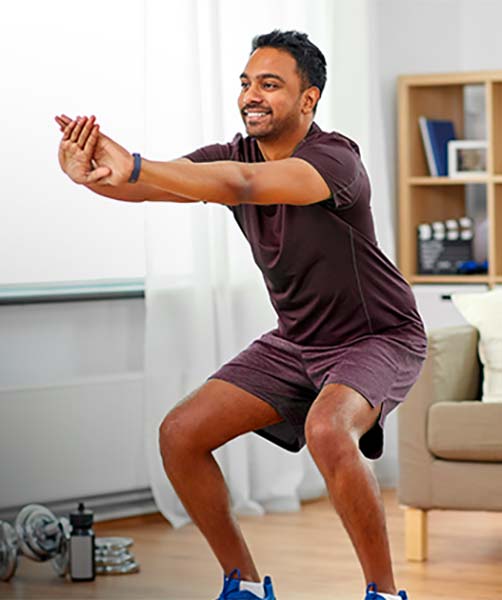
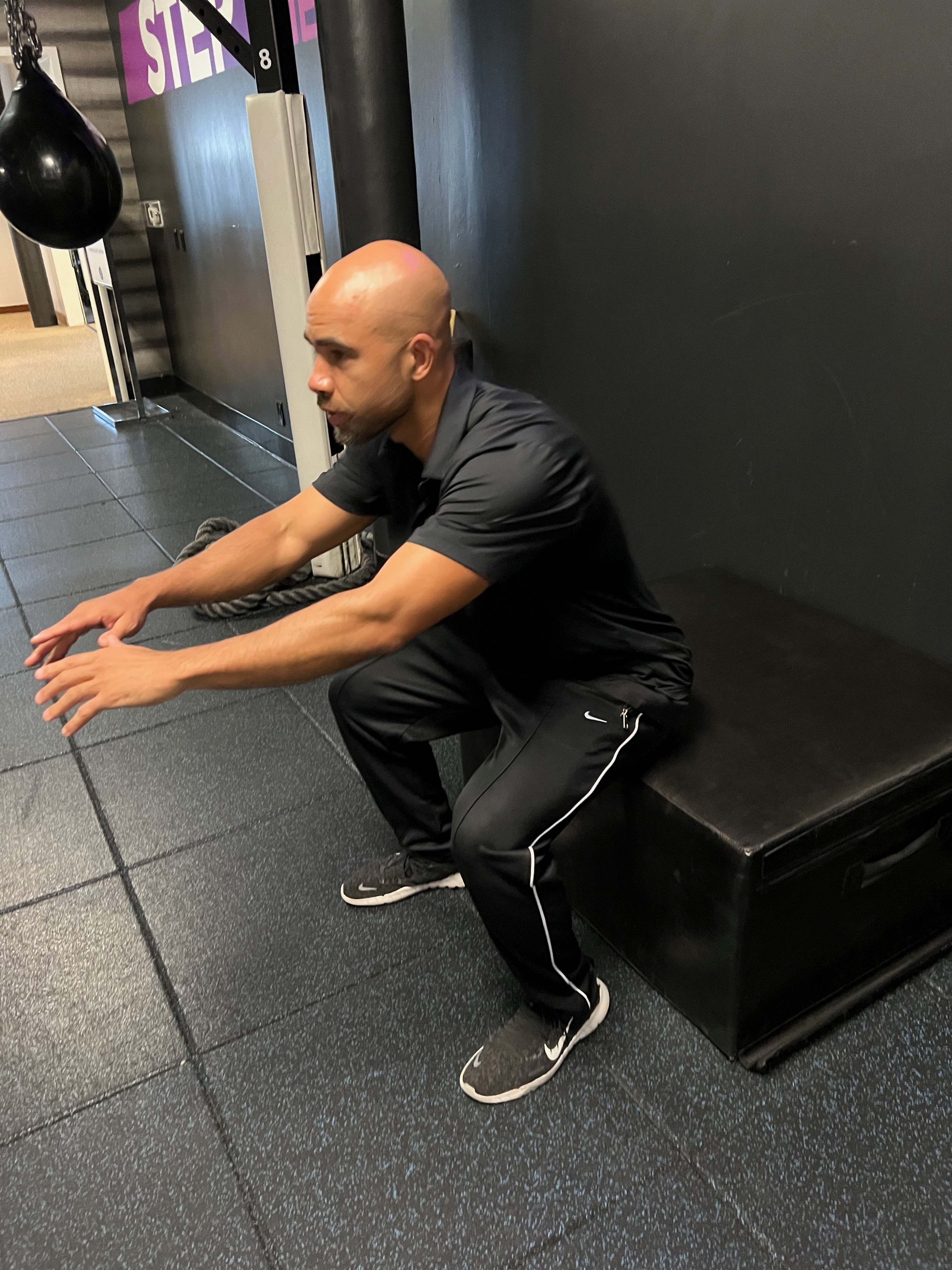
Stand in front of a box mat (or chair) and squat down, tapping your buttocks lightly and quickly standing again. Try not to plop (sit), but stand up quickly. Repeat 5X to 10X.
Stand on a mat (or in front of a mat you can kneel back on).
Take a step back with one leg and tap your knee lightly, then quickly stand up.
Alternate legs for 10 repetitions (5X each leg).
Stand on a mat (or in back of a mat you can kneel forward on).
Take a step forward with one leg and tap your knee lightly, then quickly stand up. Alternate legs for 10 repetitions (5X each leg)
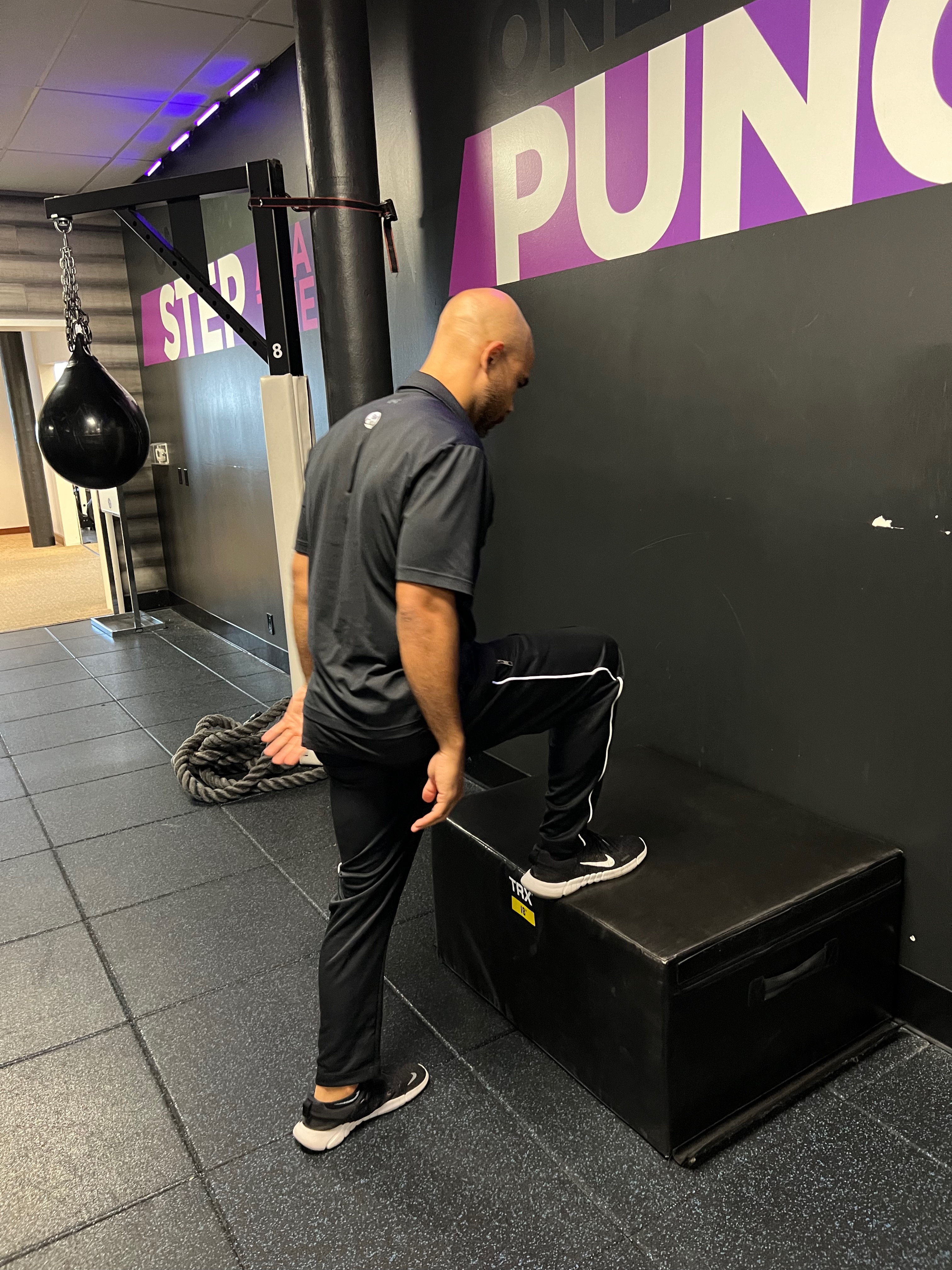
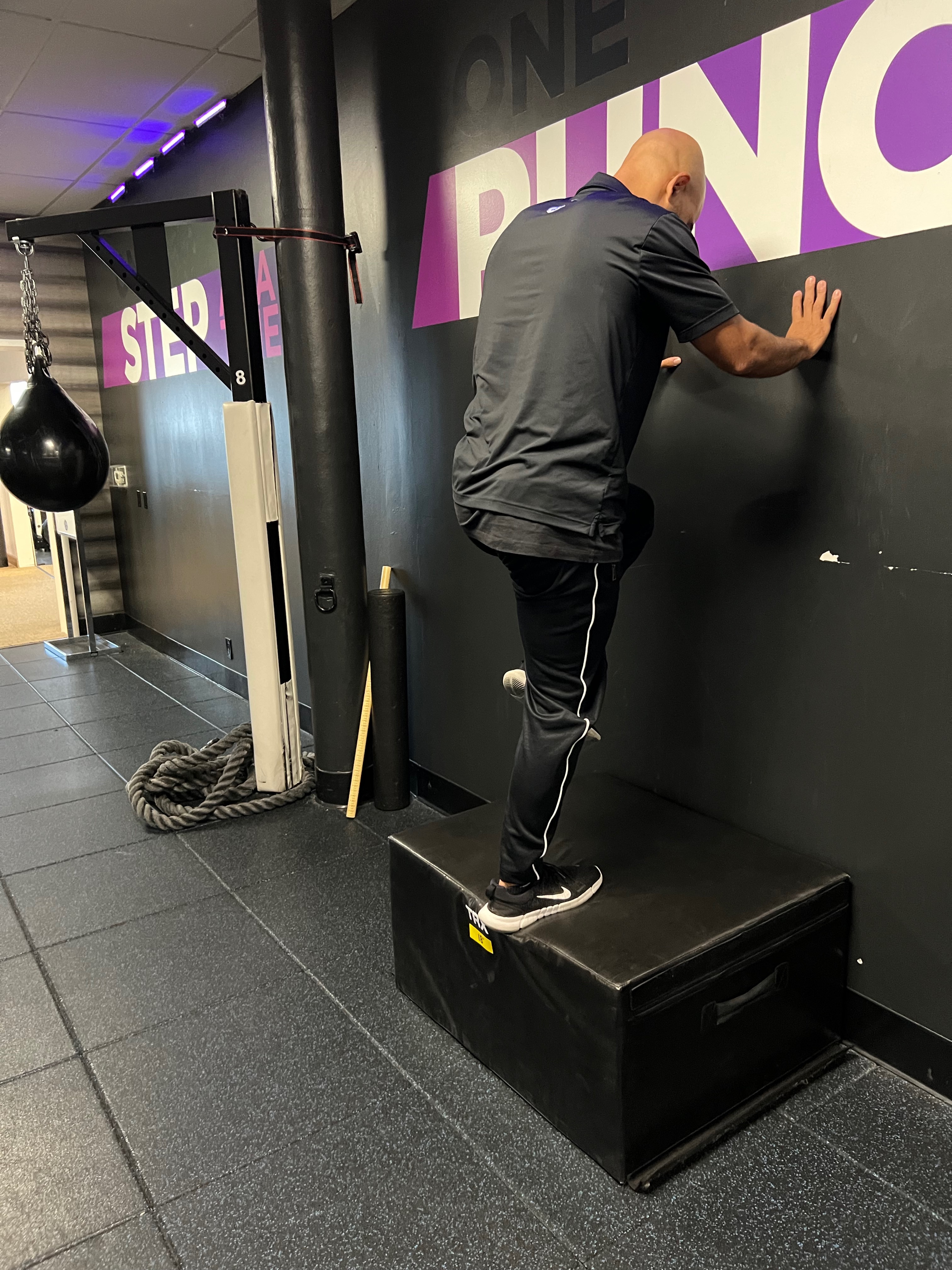
Stand in front of the foam box against a wall.
Stand up with one leg, raising your other leg toward the wall with the knee forward. (You can use the wall for balance, but just tap on it, don’t lean. As you become stronger and more proficient, try not to touch the wall with your hands.)
Step back down and switch legs, alternating for 10 repetitions (5X each leg).
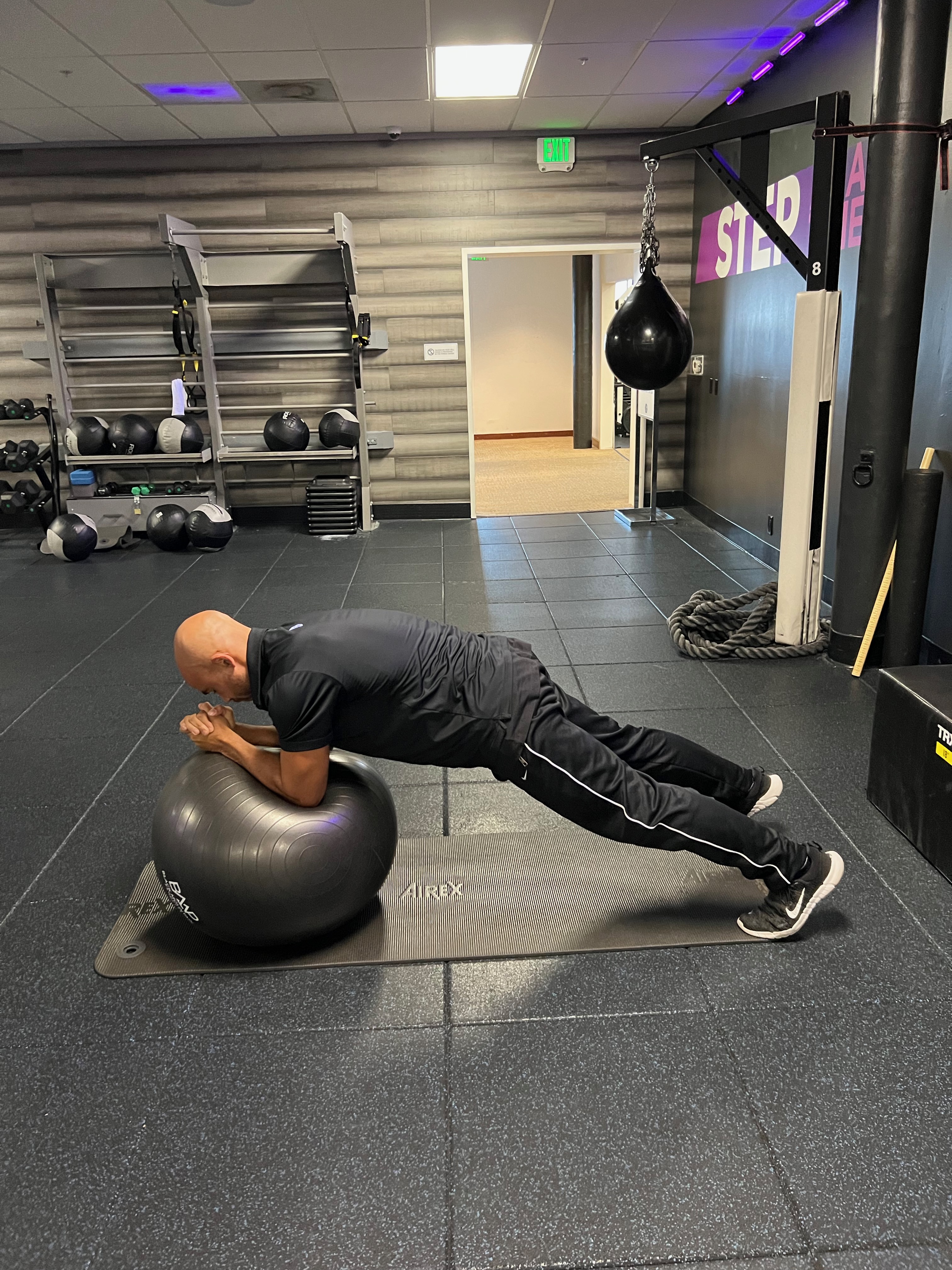
Kneel down in back of the ball and place your hands on the ball with fingers spread. Gradually roll the ball forward with your fingers and hands, until you are stretched out in a plank position with your forearms on top of the ball supporting your weight.
Keep your butt tucked in and tighten your stomach and roll back quickly from your elbows to your fingers to a standing position, keeping your stomach tight.
The quicker you do the rollback, the easier it will be to keep your balance.
Kneel down in front of the mat with your hands in front of you.
Walk your hands and knees forward until you are flat on your stomach with both arms and hands extended forward.
Spread your arms backward behind your back, then forward 5X.
Walk your arms and legs backward and stand up
Do this 4X more—
Stretch your arms backward 4X.
Stretch your arms backward 3X.
Stretch your arms backward 2X.
Stretch your arms backward 1X.
Return to a standing position.
Begin from a standing position, holding 2 weights in front of you. (Start with 5 lb. weights.)
Bend and lift the weights first to your chest.
Lift one leg so your knee is bent, thigh parallel to floor.
Raise the weights over your head, keeping arms straight, while balancing on one leg.
Bring weights down and place (or drop) them on the mat. (5X each leg.)
Stand in front of a counter or dresser, placing one heel in front of and touching the other foot’s toes. Stand for 30 seconds (try not to lean with your hands for balance). Switch feet and repeat.
When you are ready for a real challenge, try this with your eyes closed—and be sure to have something to put your hands on for balance if you tip.
From a standing position, lie on the floor with your legs straight, supporting yourself by placing one hand to your side.
With your legs together, stretch your arms to your toes as far as you can.
Spread your legs wide and lean toward the toes of each leg alternately (hold for 5 seconds).
Get back up to a standing position (use your hands on the same side you got down).
Alternate hands and sides to get up and down 5X.
Getting down on the floor and standing up repeatedly is an important exercise (as is repetitive sitting and standing) because it builds strength, balance, and flexibility and prepares the body for better balance to avoid falls and cushion impact to lessen potential injury.
Give it your best to try these exercises. Consciously try to tap lightly as you move downward. Gravity is often unfriendly, but don’t be discouraged—you will gain strength, balance, and agility over time. It’s worth it.
If you plop to the point where you’re sitting on the couch and no longer want to try, call me for some Thought Field Therapy tapping to restore your encouragement and boost motivation.
Here is a poem for inspiration:
I’m working with a trainer
To help me get more fit.
I move around and push and pound
A hundred times I stand and sit.
I’m up and down, I pull and lift,
My balance wavers, then I drift.
With exercise he whips my ass
To increase movement and muscle mass.
Oh, let me breathe and take a blow,
The lactic acid burns me so.
A pause and just a minute’s rest,
Then back to work to be my best.
The job with nature’s gravity
Forestall aging’s depravity.
Some of it’s heredity,
But most is just sedentary.
Inertia wants to be my friend.
I resist and twist and bend.
After a while the juices flow,
The knots and cramps somewhat let go.
I’m thankful I can move around
And keep away unwanted pounds.
It’s harder than it used to be.
Is part of it my memory?
I doubt the problem’s in my mind.
The body is what’s so unkind.
Years ago I was a jock,
The goal now is that hips unlock.
Science applies to physically train
The body listens to the brain
And vice versa we rehearse,
Jointly engaging, all are aging.
To make effects of time go slower
I pull and stretch higher and lower.
Eventually I’ll get much stronger.
For now, that hour seems longer and longer.
— Mark Steinberg, PhD